
Turning a Rough Sketch Into an OEM Jewelry CAD File
A rough sketch is enough to start. The design team turns hand drawings, reference photos or a written concept into a 3D CAD model inside 48 hours, and only then does the 25–30 day sampling window open. Minimum order quantities are 100+ pieces in stainless steel, 100 pcs in eco-brass and 50 units in 925 sterling silver, design by design, so a two-design range doubles those figures.

Key takeaways
- Hand sketches, reference photos or a tech pack are all accepted inputs to the CAD stage.
- The 3D CAD model and its renderings come back in under 48 hours for dimensional approval.
- Six customisation fields are settled before sampling: base material, plating, chains and findings, stones, logo and hallmarks, and packaging.
- Custom logo work uses laser engraving, with 316L for stainless steel, 18KGP for gold-plated pieces and an S925 stamp hallmarks struck on the finished piece.
What a sketch has to communicate, and what it does not
A drawing does not have to be measured to be useful. It has to show proportion, how the piece sits, and where the visual weight goes. Everything else can be rebuilt in CAD, which is why photographs of a competitor's piece with notes on what to change are as workable as a dimensioned drawing.
What a sketch cannot carry is the specification. Material, finish, stone choice and packaging sit outside the drawing and have to be stated in words, or the first sample comes back technically correct and commercially wrong.
Four inputs, one 48-hour output
Inquiry is the first step of the published six-step process, and it is deliberately undemanding: sketches, reference photos, tech packs or a written concept all qualify. The second step is a short consultation covering feasibility, material selection and cost structure, and the third is CAD.
Inside 48 hours you get a technical model plus renderings. Those renderings are the cheap place to disagree, because moving a stone or narrowing a band at that stage costs screen time, while the same change after casting costs bench time inside the sampling window.
The six fields that turn a drawing into a product
Platings: gold in 14K, 18K and 24K, or rhodium; a protective anti-tarnish e-coat on silver and brass; PVD vacuum plating for stainless work.
Chains and findings, stones and accents, logo and hallmarks, and packaging complete the list. Stones and accents cover natural stones and freshwater pearls. Logo work is high-precision laser engraving, and purity hallmarks are S925, 316L or 18KGP depending on the base metal.
Where packaging enters the timeline
It enters at the CAD stage rather than at the carton. If a piece is designed for a display backing card, its bail and chain length are decided by that card, and if it ships in a foil-stamped gift box, the box dimensions come from the finished piece.
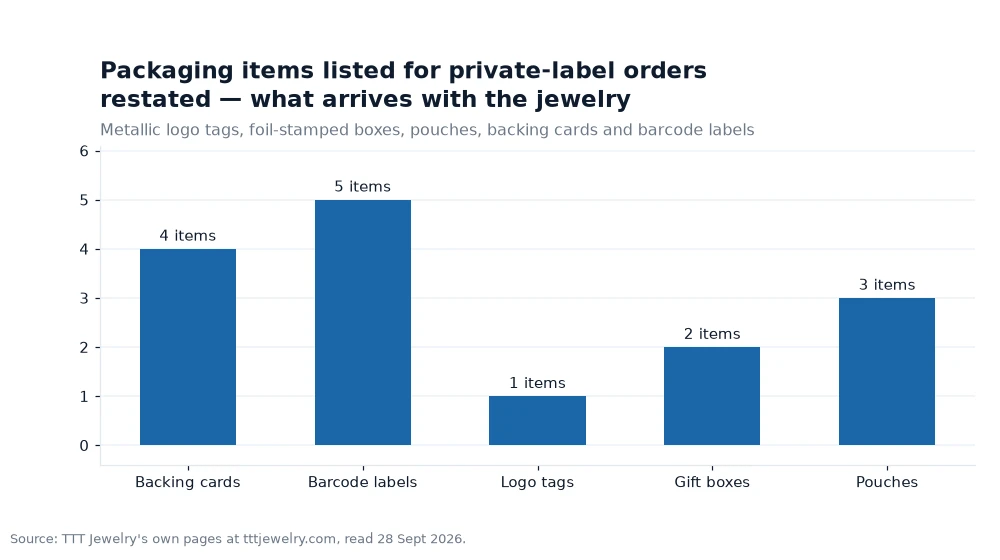
The published packaging list runs to five item types: velvet/microfiber pouches, barcode labels, display cards with backing, logo tags in metal and foil-stamped boxes. They are specified once and repeated on every batch, which is what a custom jewelry ODM solutions programme means in practice: the factory develops the piece and the shopper's first thirty seconds with it.
| Item type | Published option | Decided at |
|---|---|---|
| Logo tags | metallic logo tags | CAD stage |
| Gift boxes | foil-stamped boxes | CAD stage |
| Pouches | velvet or microfiber | CAD stage |
| Backing cards | display backing cards | CAD stage |
| Barcode labels | barcode labelling | Before packing |
Why an approved master is worth more than an approved render
A render proves the geometry. Only a physical master proves the weight in the hand, the way the plating catches light and whether the clasp feels like the price band it sits in. That is the job of the 25–30 day window, which covers wax printing, casting, stone setting, polishing and electroplating.
Both gates matter, and they are cheap in that order. Disagreeing with a render costs a day of screen time. Disagreeing with a master costs a new sample and another pass through the five bench operations.
What the renderings are actually for
The 3D renderings delivered inside 48 hours exist to settle dimensions before anything physical is made. Band width, depth, the drop on an earring, where a stone sits relative to the edge - all of it is easier to argue about on a screen than on a casting bench.
Treat the render as a drawing rather than a photograph. It is not a prediction of how the piece will catch light once it has been polished and plated, and judging finish from it is how a brand ends up surprised by the sample.
Four briefs that come back wrong the first time
The first is a quantity that excludes the packaging, so the sample arrives without the box it was designed for. The second is a plating instruction that names a colour rather than 14K, 18K, 24K gold or rhodium. The third leaves the hallmark undecided, which matters because S925, 316L and 18KGP all mean something different to a retailer.
The fourth is a reference photo with no note on what to change. A sketch plus three words about proportion is a better brief than a competitor's product shot and a shrug, and it is processed in exactly the same 48-hour CAD window.
Keeping the OEM/ODM record straight
Files are the asset in this work, and they should travel with a paper trail. The published commitment is a 100% NDA over moulds, CAD models and the collection, with designs staying exclusive to the brand that commissioned them.
ISO 9001:2015 documentation covers the production side of the same idea: what the specification was, which stage checked it, and what shipped. Both exist so that a design approved once is still recognisable several batches later.
Worked example: counting the packaging behind a first brass order
Take the brass minimum of 100 pieces per design and the five published packaging item types. A single-SKU launch at that minimum needs one of each item per piece, so 5 × 100 = 500 packaging items across the whole order, or 500 ÷ 100 = 5 per piece.
Barcode labelling is the odd one out, because it is applied rather than made; the other four are physical objects that have to be printed and stored before the jewellery arrives.
The same arithmetic at the silver minimum of 50 pieces gives 5 × 50 = 250 items. Packaging therefore halves when the launch is built in silver, which is worth knowing before you choose the metal for a design that ships in a gift box.
Frequently asked questions
Do I need a technical drawing to start?
No. Sketches, reference photographs or a written concept are accepted, and the design team converts them into a 3D CAD model with renderings inside 48 hours for approval.
When are packaging and logos decided?
At the CAD stage, alongside the six customisation fields - packaging, findings and chains, plating and finishes, the base metal, logo and hallmarks and stones and accents.
What marks go on the finished piece?
High-precision laser engraving carries the brand logo, and purity hallmarks are S925 for 925 sterling silver, 316L for stainless steel and 18KGP for gold-plated brass.
Getting a sketch to a quotable drawing
Send the idea in whatever form it exists, then state the four commercial fields in the same message: material, finish, packaging and the size of the first run. Those four decide the tooling route and the minimum that applies. The brass line covers the 100-piece route in detail, and the questions page answers the logistics that sit around the drawing.
The source for the claims above — the NDA commitment as well as the laser engraving option — is the maker's own site on tttjewelry.com, which I went through on 28 Sept 2026. Everything else is arithmetic on top of them. My re-orderings of the published facts are my own arithmetic[1].